

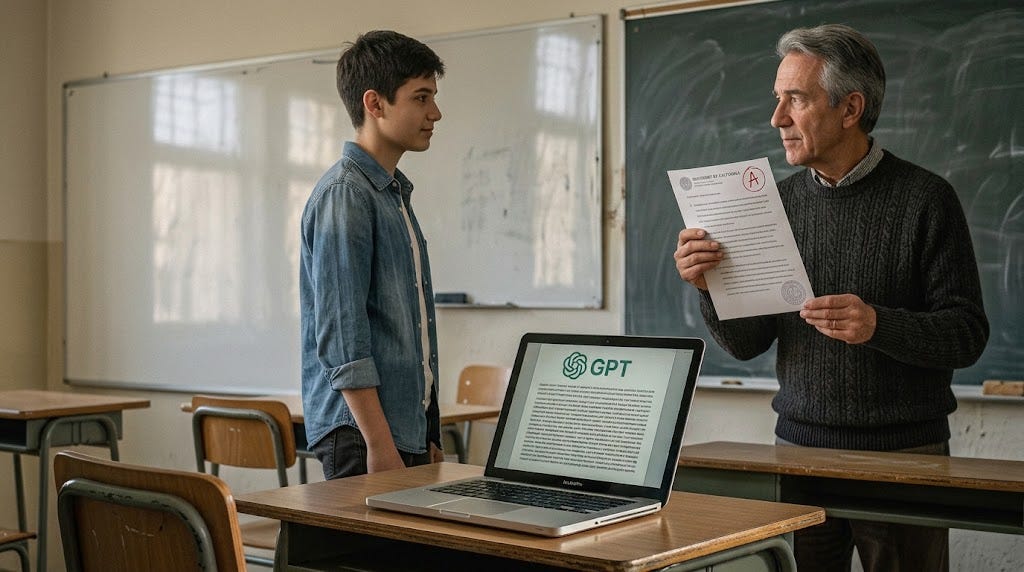
When Brown University economics professor Roberto Serrano discovered that his students had used ChatGPT on a take-home midterm, he was understandably angry.
The numbers were hard to ignore. Previous versions of the exam had produced averages between 65 and 80. This time, the average was 96, and forty students received perfect scores.
Serrano and his teaching assistants found patterns in the answers that they believed matched AI-generated responses. The professor confronted the students in class, asking why they bothered attending an Ivy League university if they were going to use AI to do their schoolwork.
He then announced that the final exam would be held in person and closed-book. The results were revealing. Twenty-two students who had scored 100 on the midterm dropped the course. When Serrano graded the final, the average fell from 96 to 48.
The professor was right to be concerned that students had used AI to pass the exam. Students who submit answers they cannot produce or explain themselves are cheating their education, regardless of the grades they receive.
But then Prof. Serrano, who earned his Ph.D. in economics at Harvard, said something that caught my attention. “We cannot choose to be idiot.”
I agree.
Which is precisely why I think the professor needs to look in the mirror.
The Temptation to Take Shortcuts is Ancient
In 423 BCE, the Athenian playwright Aristophanes staged a comedy called The Clouds. Its story revolved around Strepsiades, a father drowning in debt because of his son’s expensive passion for horses.
Desperate to escape his creditors, Strepsiades hears about a school where students learn clever arguments that can make a losing case appear to be a winning one. He decides to enroll, hoping to acquire the intellectual tools he needs to avoid paying what he owes.
His goal is revealing. He isn’t looking for an education that will make him wiser or help him solve the problems that brought him into debt. He wants a shortcut.
When Strepsiades proves unable to learn the techniques himself, he sends his son, Pheidippides, to the school instead. The young man masters the arguments and eventually uses his new skills to justify beating his own father.
Aristophanes’ comedy satirized an educational culture in which cleverness could become detached from wisdom and the ability to argue could serve the purpose of evading responsibility. The story is exaggerated for comic effect, but the temptation at its center remains recognizable: people want the rewards of intelligence without necessarily accepting the obligations that come with it.
Strepsiades wanted to escape his debts without paying them. The tools are different. Today’s student can use AI to produce excellent answers to questions, without developing the understanding those responses are supposed to demonstrate. The problem isn’t that a machine helped produce the words or numbers. It’s that the student will receive credit for knowledge and reasoning they never acquired. The temptation goes back to time immemorial.
Who Is Responsible for the Thinking?
The story of Strepsiades also exposes a problem with the way we sometimes talk about intelligence. We tend to admire clever answers, impressive results, and visible success. Those things are easy to recognize and reward. The thinking that produces them is harder to observe.
AI makes that distinction especially important. A student can submit an excellent answer without understanding the subject. The work may demonstrate what the technology can produce rather than what the student has learned.
When that happens, the student has a responsibility to be honest about the work. On the other hand, the professor has a responsibility to determine whether the assessment measures the knowledge and abilities the course is meant to develop.
Serrano’s response exposed a gap between the students’ midterm results and their performance on the final. That gap deserved attention, and he was justified in questioning how so many students had achieved perfect scores.
But the professor’s statement about stupidity invites a broader question. If students are choosing shortcuts that undermine their education, what should educators learn from those choices?
A university cannot control every decision its students make. It can, however, establish clear expectations, enforce academic standards, and design assessments that require students to demonstrate their own understanding. When technology changes the conditions under which an assignment is completed, educators must think carefully about whether their methods still accomplish what they intend. Shouldn’t that be part of the job?
Aristophanes’ story reminds us that the desire to use intelligence as a means of escaping responsibility is hardly new. The challenge has always been to distinguish genuine understanding from the appearance of competence.
Serrano was right to challenge students who appeared to have cheated. His statement about refusing to be stupid, however, applies to everyone involved in education. Students must think about the consequences of outsourcing their work. Educators must think about how they can ensure that learning actually takes place.
We cannot choose to be idiots. Students who use AI to bypass the struggle of learning will degrees without acquiring the knowledge and skills they are supposed to represent. Educators who continue using assessments that AI can easily circumvent, without adapting them to test what students actually understand, risk awarding grades for performance rather than knowledge.
If we expect students to take responsibility for their choices and learn from their mistakes, shouldn’t we expect the same from educators?