

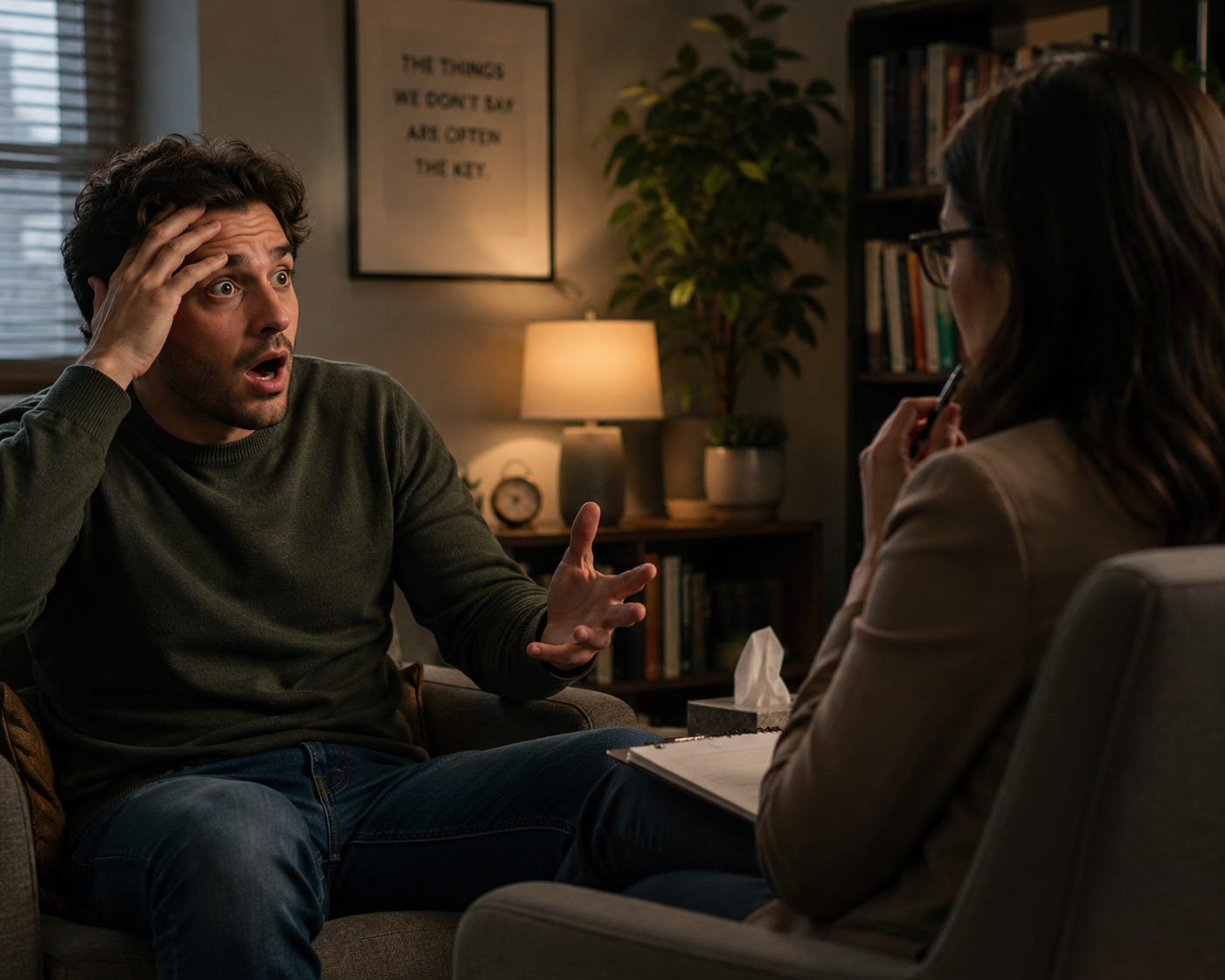
The Assumption I Never Questioned
Growing up, I heard the same message over and over: “Only crazy people go to therapy.”
There was a slight tint of disdain behind the statement, and it carried the subtext “no one goes to a shrink unless there is something wrong with them.” That was a fact. Basic common sense. Therapy wasn’t something ordinary people did. It was something reserved for people whose lives had somehow come apart.
Not For Me
How could someone like me need therapy? I had multiple college degrees. I spoke several foreign languages. I was a successful man. Friends regularly came to me for advice when they were struggling. I was the one people called when they wanted someone to think through a difficult situation. If anything, I considered myself unusually good at making sense of problems.
So when I eventually found myself sitting in a therapist’s office, it felt less like a decision and more like a surrender.
Whatever I had been doing wasn’t working anymore. I couldn’t get out of my own head, and I had reluctantly accepted that I needed help.
Reluctantly is probably an understatement. During one of my first sessions, my therapist–I’ll call him Zeus–asked a simple question.
“Are you telling your friends the same things you’re telling me?” It made me laugh, and I responded “of course not.” A totally reasonable from where I was sitting.
The Crack in the Story
Zeus was patient in a way that almost became irritating. I challenged him constantly. I questioned whether he could possibly understand what I was experiencing. I told him outright that there wasn’t much he could do for me because no one could really understand what was going on inside my head.
He never argued, he did not become defensive. He simply kept asking questions. And one day, almost casually, he mentioned that he was also in therapy. He didn’t pause afterward, nor did he seem embarrassed. He didn’t soften the statement or explain it away. Zeus simply continued the session as though he had just mentioned the weather.
Meanwhile, my brain seems to have short-circuited...
Wait...what!!!?
The news hit me like one of those moments in mythology where the world suddenly shifts beneath everyone’s feet. It felt as though Atlas had dropped the Earth directly onto my assumptions.
How could my therapist have a therapist? That made no sense. Would a plumber hire a plumbing service to unclog his kitchen sink? Would a journalist pay a ghostwriter to write his or her book? Would a cranberry farmer go to the supermarket for fresh cranberry juice?
You are the expert. You’re the one who understands the human mind. Shouldn’t you be able to solve your own problems?
When Expertise Stops Looking Like Immunity
I left that session more confused than when I had walked in and part of me felt almost betrayed. It wasn’t as if Zeus had done anything wrong. The discomfort seemed to be caused by a feeling that he had violated an expectation I hadn’t even realized I carried.
Somehow, I believed that becoming an expert meant graduating from the human condition itself. The way I was thinking about this is, if you understand emotions, you shouldn’t struggle with them. If you teach relationships, yours should be flawless. If you’re a financial advisor, your finances should be perfect.
Without ever saying it aloud, we often expect expertise to come bundled with immunity. And when reality refuses to cooperate, something inside us protests.
The Pattern Behind the Surprise
After that session, I couldn’t stop thinking about it. I eventually reached out to one of my closest friends, who happens to be a practicing psychologist. I casually asked whether she would ever feel comfortable seeing a therapist herself.
Her answer wasn’t nearly as surprising anymore. Somewhere during that conversation, I remembered an old television show called Dirty Jobs. In one episode, the host spent the day with the owner of a sewage treatment plant–a job where everything smelled terrible all the time.
Near the end of the episode, the host asked what the owner had done before entering that line of work.
“I used to be a psychologist,” he replied.
Then, with perfect timing, he smiled and said, “I decided I didn’t want to deal with other people’s shit anymore.” I laughed harder than I probably should have. But underneath the joke was something I hadn’t fully appreciated before. The people who spend their lives helping others carry emotional burdens are still carrying their own.
The Strange Standard We Set
The older I get, the more I notice this expectation everywhere. We don’t just want experts, but rather we want them to exist above the problems they understand.
We assume the marriage counselor has a perfect marriage, the grief counselor never struggles with loss and the leadership expert never doubts themselves; as though understanding something somehow exempts you from experiencing it. Maybe that’s because expertise feels safer when it looks untouchable.
It’s comforting to believe the person guiding us has already escaped the terrain we’re still trying to navigate.
But perhaps that’s never been what expertise really meant. Perhaps it has always meant becoming deeply familiar with a landscape–not somehow leaving it behind. And that reminded me of how Dr. Liet-Kynes’ expertise did not spare him from the Dune worms.
What Changed
When I walked into Zeus’s office the following week, something had shifted in me.
For the first time, I wasn’t sitting across from someone who seemed mysteriously different from the rest of us mortals. It dawned on me I was sitting across from another human being. Someone who had simply decided that understanding the mind didn’t exempt him from needing another mind to help him see his own.
Looking back, I no longer think the surprising part was that my therapist had a therapist. The surprising part was that I had spent so many years believing expertise and humanity couldn’t occupy the same person. Maybe that’s one of the quiet assumptions we carry more often than we realize–that the people we trust most should somehow stand outside the very experiences that made us trust them in the first place.